Project Scheduling - Gantt chart and other methods
Time Estimation
Time estimation is important and often somewhat underestimated in project management. When you plan a project, you must put in a buffer that is large enough to react to changes in the project and at the same time as small as possible so that you are competitive.
When you plan a project, you already know in advance that setting a time will not last. There will be tasks that take longer. Precisely for this reason, there can be a tendency to have too large a buffer, as it makes it easier for the project manager and project team if problems arise. With a large buffer, you can move the team and tasks around more easily.
Does this mean that you have to push the project team and set the time as low as possible. No, it doesn't. This means that you have to plan the project so that throughout the project you can do what is important right now. And that you can do it in a way so that there is time to do it properly and deliver a result that meets requirements and quality.
Estimating the time spent on a task can be a bit of an art. There are several factors that need to be taken into account. It is important to look at how well the task is described, whether there is anything unclear or missing definitions. You should also consider how difficult the task is in relation to the person who has to perform it. If the task is not clearly delineated and clearly defined, time consumption can quickly get out of control. With a task that is clear and distinct, it is easier to assess the time spent.
You must agree on what is important in the task. Most people tend to tackle the fun parts of the task first, and generally speaking, that's a bad way to go about it. An unnecessarily long time can be spent on the fun part of the task and the core of the task will still not be solved. The most important thing must be done first.
The person responsible for the task must believe that the task can be completed within the specified time. If he/she does not mean it, then you can expect that the time frame will not be kept. If too much time is allocated, then the person responsible will still tend to complete the task in the allocated time.
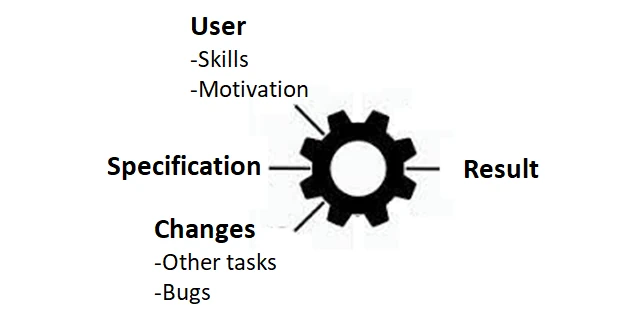
The team member's motivation is also a factor in time consumption. Motivation reduces time consumption.
Once you have estimated the time, the task will probably take at least the time expected. The phenomenon is described in Parkinson's law by Cyril Northcote Parkinson and is called Parkinson's law of time management. The book is written semi-satirically, but there is something right in this principle.
Setting the time is basically a communicative task for the project manager. The project manager must ensure that the task manager understands the task and accepts the time consumption. When this is achieved, the probability that the task will be completed within the time is greatest.
Best method for estimating time
It's one thing to get your estimate accepted, it's another thing to guess correctly.
What is the difference between a million € and a $? A millionaire has a tangible relationship question. An economics professor has a theoretical relationship. A stock trader has a practical relationship and a child cannot tell the difference. In the same way, we have different conditions for assessing a task, it is our prerequisites that determine how we assess it.
If you have to guess the number of beans in a bowl, experiments have shown that the average of the guesses will be close to the correct answer. The guesses will be distributed according to a normal distribution. People have different prerequisites for guessing and when enough people have guessed, the errors will balance each other out.
In order to eliminate the different assumptions of the team and get as accurate a guess as possible on the time consumption, you can use Trianglar distribution, Three-Point Estimation, PERT or similar technique. The purpose of the methods is to construct an approximate normal distribution for the time consumption.
Over time, knowledge is built up about the company's project models and by using the Proglar Project Model, it will be possible to estimate the time based on previous models. The assessment is based on project models from other projects, where the complexity of the models is compared to the current model for the task. The program suggests how long the task will take - however, you must be aware of how well you have defined the task. Unknown factors in a task can always cause the result to be wrong, regardless of whether AI or humans estimate the time.
Project time planning is an aspect of project management that involves creating a detailed schedule to ensure the successful completion of a project within a specified timeframe. Effective time planning is essential for keeping the project on track, meeting deadlines, and delivering results on time. There are various methods and tools available to assist in project time planning, including Gantt charts and other scheduling techniques.
A Gantt chart is a project management tool that provides a visual representation of a project schedule. Named after its creator, Henry Gantt, this chart is widely used in various industries to plan, track, and manage projects effectively.
The Gantt chart consists of horizontal bars that represent different tasks or activities within a project. Each bar corresponds to a specific task and shows the start date, duration, and end date of that task. The chart also includes milestones, deadlines, and dependencies between tasks, allowing project managers to easily identify critical paths and potential bottlenecks.
One of the key benefits of using a Gantt chart is its ability to clearly communicate the project timeline and progress to all stakeholders. By visualizing the project schedule in a Gantt chart, team members can easily understand their roles and responsibilities, track progress, and stay on schedule. This transparency and clarity help improve collaboration, coordination, and decision-making throughout the project lifecycle.
Furthermore, Gantt charts can be used to allocate resources efficiently, manage dependencies between tasks, and adjust the project schedule as needed. By updating the Gantt chart regularly with actual progress and adjustments, project managers can ensure that the project stays on track and meets its objectives within the specified timeframe.
In addition to Gantt charts, other methods such as Critical Path Method (CPM) and Program Evaluation and Review Technique (PERT) can also be used for project time planning. CPM is a technique that identifies the longest sequence of dependent tasks in a project, known as the critical path, which determines the minimum time required to complete the project. PERT, on the other hand, is a probabilistic technique that estimates the time required to complete a project by considering three time estimates for each task: optimistic, pessimistic, and most likely.
Effective project time planning involves a combination of these methods and tools to create a comprehensive schedule that accounts for all tasks, dependencies, and resources. By utilizing Gantt charts, CPM, PERT, and other scheduling techniques, project managers can effectively manage time, track progress, and ensure the successful completion of projects within the specified timeframe. It is important to regularly monitor and update the project schedule to adapt to changes and mitigate risks, ultimately leading to successful project outcomes.
The EU Working Time Directive
The EU Working Time Directive sets out rules on maximum working hours, minimum rest periods, and other aspects of working time. The directive aims to protect workers from excessive working hours, ensure adequate rest periods, and promote a healthy work-life balance.
In addition to the Working Time Directive, some EU countries have implemented specific regulations on time registration to monitor and track employees' working hours. Time registration systems can help ensure compliance with labor laws, prevent exploitation of workers, and provide transparency in terms of working hours and overtime.
That the EU also interferes in this may seem unnecessary and bureaucratic. But since we can't change it, we might as well use it to our advantage.
In Proglar, users can register time usage. Both the time they spend on the projects but also all other time. If, for example, a team member has planned a 2-week holiday, this can be registered in the system and when projects are planned, members' planned absences are taken into account.
Since all time registration is collected, it makes it possible to analyze the projects' time consumption against the expected - and costs of time consumption can be included in the cost calculations.