Skills Matrix used across all projects
A skills matrix is a smart tool that provides an overview of your team's skills and identifies who excels in what. It's all about ensuring that the right people handle the right tasks—quickly and effectively.
However, if you create a new skill matrix every time you start a project, you waste too much time and fail to leverage the matrix's full potential. Instead, you should create a matrix that encompasses all of the company's skills and use it for every new project. This approach gives you a clear view of who can do what and highlights any gaps in skills. It also allows you to determine whether to upskill employees or bring in external expertise.
By creating a skill matrix tailored to the company's needs, you can identify where upgrades are needed or ensure multiple employees possess critical skills. Remember, key skills should always be covered by more than one person.
A good skills matrix should show:
- How important a skill is to the company.
- Who possesses which skills.
- How much experience each employee has with a skill.
- When the skill was last used by the employee.
- The employee’s proficiency level.
With this overview, you can make better decisions about who to assign to which projects.
Experts are important—but they shouldn’t stand alone.
Key skills should be shared among several employees to ensure the company doesn't suffer if someone leaves. Many overlook this and simply rely on their experts staying. But if they leave, it can be costly—in both money and lost projects.
Skills need maintenance.
Some skills are like riding a bike—you never forget them. Others require regular upkeep, like a pilot's license that needs renewal each year. This applies to the business world too. If an employee has learned something valuable, it's the company’s responsibility to ensure that knowledge is used and maintained.
Train your team while you can.
It's not always the most experienced individuals who should be assigned to a project. Sometimes, it makes sense to select less experienced staff to develop their skills, with the seasoned professionals acting as mentors. This approach avoids bottlenecks and ensures the overall skill level of the company grows. It’s a win-win for everyone.

Combine experienced and inexperienced team members for optimal results.
An effective project team includes both experienced and inexperienced members. The inexperienced often ask the “annoying” questions like, “Why do we do it this way?” In 99 out of 100 cases, the answer is that experience has shown it’s the best approach. But once in a while, these questions lead to smarter solutions. Experience is invaluable, but fresh eyes and new perspectives can elevate the company’s knowledge and sharpen its edge.
How to use a skills matrix
A skills matrix provides an overview of what the company is capable of—and what it needs. Start by listing all the skills your company uses. Then divide them into:
- Internal skills:What should you handle in-house?
- External skills:What can be outsourced effectively?
For example, expert knowledge requiring specialized equipment or highly niche expertise might be more cost-effective to source externally.
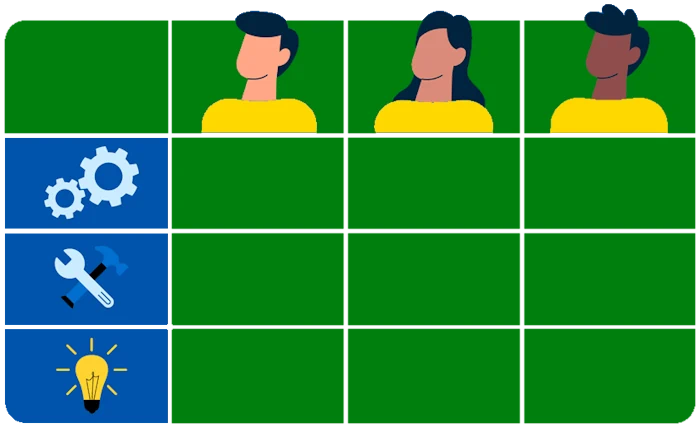
Internal skills can be further divided into:
- General skills: Skills that all employees should have.
- Expert skills: Skills that only a few employees have deep expertise in.
Map your team
Next, review your staff: Who has which skills, and at what level? For external skills, it’s a good idea to identify multiple potential suppliers to ensure you always have a backup.
Keep the skills matrix updated
Continuously add new skill needs and adjust as employees develop new skills. This ensures the matrix remains a reliable tool for use across all projects.
How to select the right team for projects
Once the project manager has an overview of the tasks involved in a project, they can quickly match the required skills with the company's skills matrix. This makes it easy to assemble a team that not only completes the project efficiently but also contributes to the company’s growth.
A skills matrix that covers all the company’s skills saves time, provides clarity, and helps you maximize resources—both in the short and long term.